Breaking the Cycle of Failed Peace Negotiations
Elza S. MaaloufBreaking the Cycle of Failed Negotiations
This post was initially intended to be on the Build Palestine Initiative blog of our sister website for the Center for Emergence Middle East
We are experiencing technical difficulties with the blog section on the website, but wanted to inform followers of our work of this important upcoming event.
For many reasons US Middle East policy has failed to make lasting peace a reality. Early on in his administration, President Obama sent a message to the world that things will be different. By granting his first media interview to Al-Arabia Network based in Dubai and delivering a powerful speech in Cairo to the Muslim world he set the tone for things to be different. But, how much beneath the tactical surface would policy makers need to go in order to achieve a different, sustainable outcome. At the Washington summit this past August with President Abbas and Prime Minister Netanyahu, Secretary Clinton and President Obama set a one year deadline for both parties to come up with a workable peace treaty. Is this approach any different than that of previous administrations and would it work?
These are questions that Dr. Don Beck, Said Dawlabani and I will be discussing during Peace Week this coming Wednesday September 15, at 5:00 PM (PST). Click here for details and to sign up.
- Are the two parties ready to step fully into these negotiations, or is this Washington's own timing leading to mid-term elections?
- It is true that Prime Minister Fayyad is doing a good job with making sure that Palestinian security forces in the West Bank are well trained, but is that enough for Israel to pull back its 10,000 troops?
- With all right wing opposition in Israel opposing the settlement freeze, can the Palestinians trust that Israel has good intentions at the table?
- Most importantly, are all parties, including the US, looking at these negotiations from a Natural Design perspective? From a value systems perspective? Do they take into account the memetic contours and the lay of the land in both cultures? Or, are they coming to it from the traditional negotiations processes that failed to achieve tangible results in Madrid, Oslo, and Camp David.
The truth is, whoever is at the negotiations table does not represent the full spectrum of value-systems and mindsets of their respective cultures. Why isn't there a bottom-up referendum on the future of their respective countries? Who's really addressing what the moderates in both countries are looking for? This is something that the Center for Human Emergence Middle East has been deeply involved in for the last five years. We have uncovered and informed, through our field-tested framework, the thinking of over 200,000 in Palestine who are of the mindset that in order for negotiations to be successful and have collective support, the negotiators must be informed by real-time data from the trenches of the culture.
Below is a reposting from a year ago of our call for a "Design Conference" and not a "Peace Conference". Not much has changed in calling for the building blocks that form the foundation for a lasting peace.
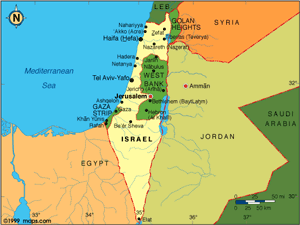
Design Conference for Palestine/Israel
To Break the Cycle of Failed "Peace Negotiations"
The Israeli/Palestinian conflict is a collision of “tectonic plates” — deep values system codes — that have created a logjam. It is this underlying logjam that generates continual surface-level blockages that erupt in conflict.
We propose a problem-solving methodology with the power, precision, and complexity to create a scaffold for human groupings to construct the unique economic and political structures that support the healthy evolution of those groupings.
We need to see the patterns as through a prism — where all the various colors of worldviews are made visible, each with a different “tint” on the world. The goal is to understand the needs of all the mind-sets, so as to begin to craft “full-spectrum” solutions which are fundamentally different from those that a single perspective would offer. This would:
- Develop the capacity to uncover the deeper dynamics within each society, as well as between societies.
- Craft decisions and measure priorities not against the past, nor based on who is responsible for what.
- Avoid the typical problem resolution systems such as majority rule, rule by the elite or by the wealthy, or rule by the so-called experts, or those that have military strength.
- Defuse the ideologies that produce “us vs. them”.
- Avoid raising expectations which can be faulted.
- Focus on who the people are who live in the region and what their resources are.
- Design a strategy to mesh people, geography, and resources together into a workable solution for all who live in that region.
- Draw upon all of the solutions which are currently available (as well as many that haven’t been thought of yet) to create a scaffolding of solutions for the whole region.
- Generate solutions that involve the whole region: Israel, Syria, Jordan, Palestine, and the other players who have influence in the conflict.
"The issue is less about democracy, rather the question is to design the best structures for meeting the needs of the people as they develop through the stages that are most natural to them; open, adaptive systems appropriate to their life conditions."
Labels: Design conference, Israel, Natural Design, Palestine, peace conference


 I don't give President Obama high marks on several foreign policy issues, yet when it comes to his tempered response to the 'sham' elections in Iran, I fully support his stance.
