Tuesday, September 14, 2010

Breaking the Cycle of Failed Peace Negotiations

Elza S. Maalouf
Tuesday, September 14, 2010

Breaking the Cycle of Failed Negotiations

This post was initially intended to be on the Build Palestine Initiative blog of our sister website for the Center for Emergence Middle East

We are experiencing technical difficulties with the blog section on the website, but wanted to inform followers of our work of this important upcoming event.


For many reasons US Middle East policy has failed to make lasting peace a reality. Early on in his administration, President Obama sent a message to the world that things will be different. By granting his first media interview to Al-Arabia Network based in Dubai and delivering a powerful speech in Cairo to the Muslim world he set the tone for things to be different. But, how much beneath the tactical surface would policy makers need to go in order to achieve a different, sustainable outcome. At the Washington summit this past August with President Abbas and Prime Minister Netanyahu, Secretary Clinton and President Obama set a one year deadline for both parties to come up with a workable peace treaty. Is this approach any different than that of previous administrations and would it work?


These are questions that Dr. Don Beck, Said Dawlabani and I will be discussing during Peace Week this coming Wednesday September 15, at 5:00 PM (PST). Click here for details and to sign up.

  1. Are the two parties ready to step fully into these negotiations, or is this Washington's own timing leading to mid-term elections?
  2. It is true that Prime Minister Fayyad is doing a good job with making sure that Palestinian security forces in the West Bank are well trained, but is that enough for Israel to pull back its 10,000 troops?
  3. With all right wing opposition in Israel opposing the settlement freeze, can the Palestinians trust that Israel has good intentions at the table?
  4. Most importantly, are all parties, including the US, looking at these negotiations from a Natural Design perspective? From a value systems perspective? Do they take into account the memetic contours and the lay of the land in both cultures? Or, are they coming to it from the traditional negotiations processes that failed to achieve tangible results in Madrid, Oslo, and Camp David.

The truth is, whoever is at the negotiations table does not represent the full spectrum of value-systems and mindsets of their respective cultures. Why isn't there a bottom-up referendum on the future of their respective countries? Who's really addressing what the moderates in both countries are looking for? This is something that the Center for Human Emergence Middle East has been deeply involved in for the last five years. We have uncovered and informed, through our field-tested framework, the thinking of over 200,000 in Palestine who are of the mindset that in order for negotiations to be successful and have collective support, the negotiators must be informed by real-time data from the trenches of the culture.

Below is a reposting from a year ago of our call for a "Design Conference" and not a "Peace Conference". Not much has changed in calling for the building blocks that form the foundation for a lasting peace.
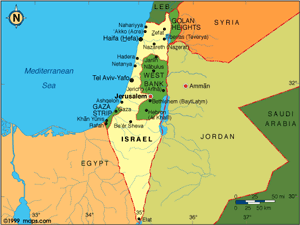


Israel Palestine Regional Map


Design Conference for Palestine/Israel
To Break the Cycle of Failed "Peace Negotiations"

The Israeli/Palestinian conflict is a collision of “tectonic plates” — deep values system codes — that have created a logjam. It is this underlying logjam that generates continual surface-level blockages that erupt in conflict.

We propose a problem-solving methodology with the power, precision, and complexity to create a scaffold for human groupings to construct the unique economic and political structures that support the healthy evolution of those groupings.

We need to see the patterns as through a prism — where all the various colors of worldviews are made visible, each with a different “tint” on the world. The goal is to understand the needs of all the mind-sets, so as to begin to craft “full-spectrum” solutions which are fundamentally different from those that a single perspective would offer. This would:

  • Develop the capacity to uncover the deeper dynamics within each society, as well as between societies.
  • Craft decisions and measure priorities not against the past, nor based on who is responsible for what.
  • Avoid the typical problem resolution systems such as majority rule, rule by the elite or by the wealthy, or rule by the so-called experts, or those that have military strength.
  • Defuse the ideologies that produce “us vs. them”.
  • Avoid raising expectations which can be faulted.
  • Focus on who the people are who live in the region and what their resources are.
  • Design a strategy to mesh people, geography, and resources together into a workable solution for all who live in that region.
  • Draw upon all of the solutions which are currently available (as well as many that haven’t been thought of yet) to create a scaffolding of solutions for the whole region.
  • Generate solutions that involve the whole region: Israel, Syria, Jordan, Palestine, and the other players who have influence in the conflict.

"The issue is less about democracy, rather the question is to design the best structures for meeting the needs of the people as they develop through the stages that are most natural to them; open, adaptive systems appropriate to their life conditions."


Labels: , , , ,

Sunday, May 03, 2009

Natural Design principles for Madrasas in Pakistan and Afghanistan

Elza S. Maalouf
On today's Fareed Zakaria's show, GPS, Secretary of Defense Robert Gates admitted that power alone will not achieve the US' goals in Afghanistan, Iraq and Pakistan. In the Secretary's speech to the National Defense University he stressed that "Our National Defense Strategy is BALANCE..." Included in this strategy is counter-insurgency operation manuals, Special Forces and Navy programs and "A variety of initiatives are underway that better integrate and coordinate U.S. military efforts with civilian agencies as well as engage the expertise of the private sector, including NGOs and academia."

I did not expect the Secretary of Defense in his speech at NDU to go into details on how to integrate military and civilian efforts. This lack of specificity has been a theme with Clinton, Gates and even Zoellick, president of the World Bank. They all talk about integrated efforts, smart power and societal issues as a complementary part to their strategies, a kind of a by-product that they stumbled upon when their initial strategies did not work. These societally-fit and culturally-fit strategies should be an integral part of our defense, diplomacy and development strategies. In light of the failures we face — economic, political and military — the central theme of our Foreign policy has to change to include at its center a comprehensive understanding of the underlying codes of the cultures we operate in.

This is the basis of the value-based concept of Innovations in Memetic Technologies — IMT® for short. I have been developing these value-based technologies throughout the years of my work in tribal and feudal cultures, from the early days of being a community organizer and attorney in the Middle East, and later framed by my work with Dr. Don E. Beck on his Large Scale Branch of Psychology.


One of the most effective tools we use in IMT® is based on the framework of Natural Design Principles (Graves-Beck) which in its simplest form asks the following questions in order of importance:


  1. WHERE (Geo-Social Landscape) are these people we want to lead/teach/reform?

  2. WHAT is the overarching goal of this project or intervention?

  3. WHO are they? What are their capacities? Their Value-systems? their belief-systems? their history? religion? tribal loyalties etc....

  4. After assessing these essential element of our systemic strategies for change, we now decide on HOW to implement this change? and Change from WHAT to WHAT?

Reforming Madrasas Based on these Principles:

Madrasas' Islamic education has been an important part of the educational system in Afghanistan and became increasingly important in Pakistan, especially after 9/11 as it became a fear-based defense of Islam against the "onslaught of the West." Madrasa literately means "school" in Arabic, but in the context of these two countries, it is translated in a strict adherence to the study of the Quran and to extreme teachings of Islam. A good Muslim is encouraged to memorize the Quran, and sadly the feudal tribes and strategic exploiters use such nobel purposes to manipulate students into their self-serving ideologies and to fulfill their dreams of a radicalized brand of Islamic Imarat.

These Saudi-financed madrasas operated in poor areas where there was no access to education, and many of the Taliban were educated in these institutions that teach the Wahhabi brand of Islam. Wahhabism was initiated in Saudi Arabia to rid Islam of innovation and bring it back to a literal translation of the Quran. Initially, the Saudis used the Madrasas to counteract the Soviet spread in Afghanistan. A good idea at the time (maybe) that turned toxic and focused on extremism and hatred of the West. Unfortunately, neither the Saudis nor the successive US administrations at the time had social scientists or psychologists to help analyze how such institutions will affect future generations in tribal and feudal cultures.

Now, with hundreds of books and volumes of research written about this subject, the issue we're facing is what to do about these madrasas:
Do we shut them down and restart the educational system with weak governments and weak security forces? if not, how can we deal with the new generation of Taliban that these madrasas are producing?
Using the above stated steps, we start by looking at the Life Conditions surrounding these madrasas: poor neglected areas with cult figures of Taliban giving a sense of identity and a sense of purpose to kids who know they would have amounted to nothing unless they belonged to a powerful clan like the Taliban. "Going to heaven and meeting the 72 virgins" is not the main attraction in many cases. It is unfortunately money. Making a living, supporting their parents and later their families, and having a status in the community are the biggest attractions to these young men. In a culture where the cast system is prevalent, having a status in society by any means is important. The governments in these countries, like in many developing countries are consumed by corruption and most politicians put self-interest ahead of National interest. Billions of dollars in aid over the years, have been re-directed to leaders personal bank accounts abroad, and donor countries always failed to avoid these pitfalls. (This is a very similar situation to Hezbollah's rise in Lebanon.)

Considering these facts and other external/Western factors that contributed to the rise of fundamentalism, it would be wise to keep the already existing madrasas and start with subtle changes led by religious authorities who are passionate Muslims, but not antagonistic to development and progress. The religious structure of madrasas and mosques can serve a great purpose in the lives of Pakistanis and Afghans if imbued with the right content of teachings.

I recommend the initial steps for change to be the following:

  • Lincense the madrasa teachers. A program to license the teachers of madrasas with higher wages and cash bonus incentives. Licensing would mean that they adhere to a common curriculum that teaches the true spirit of Islam, and can be monitored by community leaders and the council of elders. Tribal communities hold a lot of respect to their elders, and reject outside interventions from police and government. (This would help honor the traditions of the tribes and clans while subtlly changing cultural implications and creating an open society)

  • Draw from the legacy of Muslim scientists and history. Adding Math and Science to the exclusively religious content, based on the work of great Muslim scientists like Averos (Ibn Sina) and Al-Bayruni whose contribution to physics and mathematics give Muslims a lot of pride.

  • Add Music curricula for brain development. Music should be an essential component of these schools: since the Taliban despise music, maybe religious chanting with the use of simple instruments can be a place to start.

  • Call on the grandmothers. Kids at the age of 5 and 6 years old from these madrasas are now joining the Taliban, and are taught not speak to women; which makes it hard for women in those circles to have much influence. However, grandmothers are always respected and feared and, if well informed, they can positively influence the minds of these young boys.

A comprehensive plan should be designed for such change to happen, one that coalesces the efforts of our Defense Department, State Department, local governments, NGOs and local community programs. I have only touched on key points that might start the process. This is to show that we cannot keep throwing money at the Pakistani military (the US gave more than 10 Billion to the Pakistani army in the last 8 years), without having an equal strategy to change the habitat that is creating those extremist cells. That is the "balance" that needs to take place along with the military, counterinsurgency and economic strategies to help that region. If such coalescence takes root our entire Foreign policy will be redefined to be more effective, respectful and sustainable.

Labels: , , , , , , , , , , , , ,